Lameness examinations
Lameness is one of the most common reasons for veterinary visits. It is important to remember that lameness is only a symptom, which can be due to a number of different causes. Therefore, it is important to first investigate where the lameness is coming from and what the underlying problem is.
Examination methods
First and foremost, the veterinarian feels the horse’s muscles, tendons and joints, in a process called palpation. They also look at whether the horse is evenly muscled and how it is shod to try to find the cause of lameness. Then a movement check is done, where the horse is allowed to move in different gaits, on straight and curved tracks and on different surfaces, so that the veterinarian can see movement patterns and how and when the horse shows lameness without provocation.
Flexion test
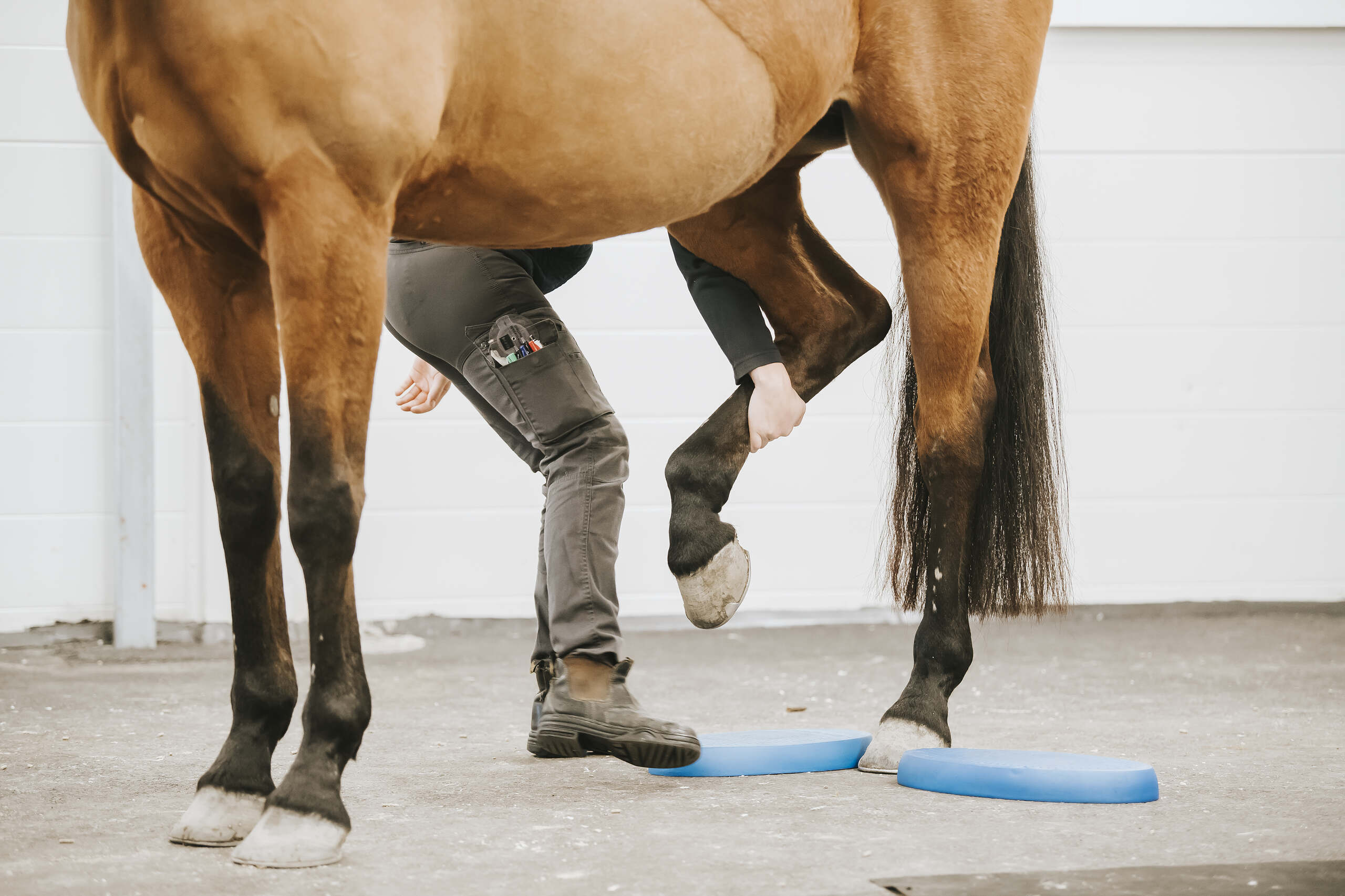
After the initial examination, provocation tests are performed to get some clues to where the pain is coming from. The most common provocation test is called the flexion test. In this, different parts of the horse’s legs are flexed for a certain time and then the horse is immediately put into a trot. Any reaction to the test can give an indication of whereabouts the horse’s problem lies.
Anaesthesia
Once the initial examination and tests have been carried out, the veterinarian often has a rough idea of where the problem is, but in order to be able to pinpoint exactly where it is, the next step is often to administer anaesthesia. This is when the area where the problem is suspected is numbed and the horse is then observed in motion. If the anaesthesia causes the lameness to disappear, the veterinarian can feel confident that they have found the source of the problem. Sometimes, several areas may need to be anaesthetised to find the right area, which could mean several visits to the veterinarian.
Treatment
Treatment of joints
Joint diseases and inflammation in the joints are common causes of lameness in horses. Early diagnosis and correct treatment are crucial to reducing pain, slowing the progression of the disease and enabling a quicker return to work.
Joints can be treated with several different medications and biological treatments, depending on the horse’s status, diagnosis, the extent of the injury and whether it is an acute or chronic problem.
The key to all joints treatments is hygiene and sterilisation to avoid infections, which is why the area where the horse is to be injected is first of all clipped and sterilised. It is also worth knowing that all treatment involves a waiting period. The waiting period varies depending on the medication used and the diagnosis that has been made.
Cortisone
Cortisone is one of the most common types of medication used for joint inflammation. There are several different types of cortisone, all of which are potent anti-inflammatories and which act in a similar way to the body’s own cortisol. The medication is injected into the joint and reduces swelling, pain and inflammation.
Hyaluronic acid (cockscomb)
Hyaluronic acid is a natural component of synovial fluid and plays an important role in lubricating the joint. In joints treatments, synthetic hyaluronic acid is injected into the joint to improve the quality of the synovial fluid and reduce inflammation.
Polyacrylamide hydrogel
Polyacrylamide hydrogel (PAAG) is an alternative for joint treatment and consists of a synthetic and water-based gel that is injected into the joint. The gel is integrated into the joint tissue and acts as a long-acting lubricant and shock absorber. Please note that this treatment entails a lifetime withdrawal period from competitions in Sweden.
Mesotherapy
Mesotherapy is a treatment method used to relieve pain and muscle tension. Small amounts of the drug are injected superficially into the skin over points along nerve pathways and trigger points. This affects the nervous system and can help to reduce pain signals, improve blood circulation and create muscle relaxation.
Ultrasound-guided injection (USGI)
In some treatments, ultrasound guidance may be appropriate, to ensure that the drug is injected in exactly the right place. In this case, the area is scanned with ultrasound at the same time as the cannula is placed, so you can see where the needle tip is and where the drug is being deposited. We use this technique for facet joints in the neck, SI joints, elbow joints and hip joints, among others.
Biological drugs (orthobiologics)
Biological drugs are made from blood or other tissues from horses. Some of these drugs are made from the horse’s own blood or cells (autologous), and others from donors (allogeneic). The advantage of these drugs is that they use the body’s own healing ability to be more focused on the area where it is needed. This avoids the use of synthetic drugs where the risk of side effects is higher, especially with repeat treatments.
IRAP (ACS)
With IRAP, the horse receives a higher concentration of its own anti-inflammatory protein: interleukin 1 receptor antagonist. IRAP is an autologous preparation where the horse’s own blood is taken and a serum is prepared that is then used to treat joint inflammation. Usually, about 200 ml of blood is taken and that is enough for several doses. It takes about a day to prepare the agent, so treatment can begin at the earliest the day after the blood has been taken. If not all doses are needed for treatment, the remainder can be stored in the freezer for up to a year.
PRP/PRF (Platelet-rich Plasma/Fibrin)
Both PRP and PRF are autologous preparations used for joint inflammation and tendon and ligament injuries. Here, a small amount of blood is taken from the horse, which is then centrifuged to separate out the red blood platelets. What remains is a preparation that is rich in thrombocytes, white blood cells and proteins. The process of preparing the preparation takes between 10 and 50 minutes, so the treatment can begin during the same session after the blood has been taken.
Stem cells
Stem cell therapy is primarily used to treat osteoarthritis (arthritis). There are two stem cell medicines registered for horses in Sweden. Both consist of allogeneic mesenchymal stem cells: cells that have been donated and can develop into other types of cells. Stem cells contribute to healing of the joint and reduce inflammation. The medicines are ordered in advance and can be stored in a special freezer until the time of treatment. There are also processes where stem cells are extracted from the horse to be treated.
Contact us for a lameness examination of your horse
Contact your nearest clinic, via email or phone, to book an appointment for a lameness examination.